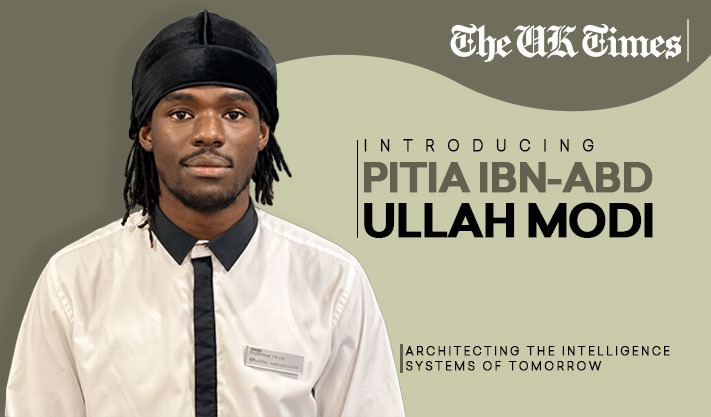
Pitia Modi Interview
As artificial intelligence, quantum integration, and secure computational infrastructure reshape the global technology landscape, a new generation of founders is emerging with a focus on resilient, mission-critical systems. Across sectors such as defense, aerospace, and advanced computing, the demand for intelligent architectures capable of operating securely under extreme conditions has never been greater.
At the forefront of this movement is Pitia Modi, Founder and Systems Architect of Modi Intelligence Innovations Lab. Through advanced frameworks such as the CQI system and the Modian Helix Protocol, Modi is developing next-generation computational architectures designed to unify artificial intelligence, quantum-informed systems, and secure interoperability.
With a highly unconventional path into deep technology, combining a background in psychology with years of intensive independent research in systems engineering, quantum mechanics, and high-performance computing, Modi represents a new model of multidisciplinary innovation.
In this conversation with The UK Times, Pitia Modi discusses the philosophy behind Modi Intelligence Innovations Lab, the future of quantum-integrated systems, and the long-term vision driving his work across Canada and globally.
BUILDING MISSION-CRITICAL INTELLIGENT SYSTEMS
The UK Times: What is the core mission behind Modi Intelligence Innovations Lab, and how does it differentiate itself in the deep-tech landscape?
Pitia Modi: The core mission of Modi Intelligence Innovations Lab is to bridge the gap between theoretical breakthroughs and operational reality in deep technology. We focus on transforming advanced concepts in AI, quantum systems, and secure infrastructure into deployable, mission-critical solutions.
What differentiates us is our systems-first philosophy. Instead of building isolated tools, we engineer cohesive architectures like the CQI system and the Modian Helix Protocol that enable real-time coherence, resilience, and secure interoperability across domains such as defense and aerospace.
Our approach is not just innovation for its own sake, but innovation that performs reliably under extreme conditions.
At the same time, this mission is deeply informed by my personal journey. I am of South Sudanese origin, born in 1999 in Amman, Jordan, to parents who fled South Sudan during the Second Sudanese Civil War. My early life included a brief period in Cairo, Egypt, before immigrating to Canada at the age of three.
I was raised and educated in Thunder Bay, Ontario, an environment that played a foundational role in shaping both my character and my early exposure to technology. That trajectory, from displacement to opportunity, continues to shape how I think about building systems that are resilient, adaptive, and globally relevant.
THE CQI SYSTEM AND MODIAN HELIX PROTOCOL
The UK Times: Can you explain the significance of the CQI system and the Modian Helix Protocol in shaping next-generation intelligent systems?
Pitia Modi: The CQI system and the Modian Helix Protocol are foundational frameworks I developed to address one of the most critical challenges in modern computing: maintaining coherence and trust across complex, distributed environments.
The CQI system ensures continuous quantum-informed intelligence alignment, allowing systems to operate with synchronized awareness in real time. The Modian Helix Protocol introduces a layered architecture for secure computation and adaptive intelligence flow.
Together, they form a backbone for systems that are not only intelligent but also resilient, self-validating, and capable of operating across multiple domains without fragmentation or compromise.
These systems are the result of months of intensive independent study and self-directed research across disciplines such as systems architecture, high-performance engineering, and quantum mechanics, fields I pursued outside of my formal academic training.
ENGINEERING FOR DEFENSE AND AEROSPACE
The UK Times: How do you approach building secure and high-performance systems for sensitive sectors like defense and aerospace?
Pitia Modi: My approach is rooted in first-principles engineering and threat-aware design. In sectors like defense and aerospace, systems must operate with absolute reliability and security under unpredictable conditions.
We begin by modeling the entire operational environment, including adversarial scenarios, system stress points, and integration constraints. From there, we design architectures that embed security at the core rather than treating it as an afterthought.
Performance is achieved through optimization at both the hardware and algorithmic levels, often leveraging quantum-integrated methods and advanced AI orchestration. Every system undergoes rigorous validation to ensure it meets mission-critical standards before deployment.
This mindset is also a reflection of how I learned, through building from the ground up. My formal background is in psychology, with a Bachelor’s degree from the University of Windsor, where I also completed multiple computer science courses as electives.
However, much of my work in deep technology has been self-directed, beginning with my first exposure to programming at age 16 and evolving into advanced independent study. That path required a level of rigor and discipline that directly informs how I design systems today.
THE FUTURE OF QUANTUM INTEGRATION
The UK Times: What role does quantum integration play in your work, and how do you see it evolving in real-world applications?
Pitia Modi: Quantum integration is a key pillar of my work because it introduces fundamentally new ways of processing information and solving complex problems.
However, my focus is not on theoretical quantum advantage alone, but on hybrid systems where quantum and classical architectures work together seamlessly. This allows us to achieve practical gains in areas such as optimization, cryptography, and real-time decision systems.
As the technology matures, I see quantum integration becoming an embedded layer within critical infrastructure, enhancing capabilities without requiring organizations to fully transition to quantum-native systems.
This vision is part of a broader architecture I developed independently, a unified, multi-domain computational system that integrates classical and quantum-aligned frameworks into a cohesive whole.
LEADERSHIP, INNOVATION, AND GLOBAL IMPACT
The UK Times: As a founder and systems architect, what philosophy guides your leadership and innovation strategy?
Pitia Modi: My philosophy is centered on precision, adaptability, and long-term impact. I believe that true innovation comes from deeply understanding the problem space and designing systems that can evolve with it.
As a leader, I prioritize building teams that think in systems, not silos, and encourage a culture of rigorous thinking combined with bold experimentation.
At Keji Capital Inc and Modi Intelligence Innovations Lab, the goal is not just to create advanced technology, but to define new standards for how intelligent systems are built, secured, and deployed in the real world.
At the same time, I think it is important to recognize the broader significance of this work. To my knowledge, I am among the first individuals of South Sudanese origin operating at this level within the deep-tech landscape.
That represents more than a personal milestone. It signals to communities globally, particularly across the African diaspora, that contributing to the highest levels of innovation does not require traditional pathways or permission.
My focus now is on scaling this platform across Canada and globally, while also creating pathways to bring advanced technological infrastructure and opportunity to the African continent.
Ultimately, I want the work to stand on its technical merit, but also to reflect a deeper narrative, one of resilience, self-determination, and long-term vision, grounded in substance, rigor, and real-world impact.
CONCLUSION
Through Modi Intelligence Innovations Lab, Pitia Modi is building a systems-driven framework for the future of intelligent infrastructure. By integrating artificial intelligence, quantum-informed architectures, and secure computational design, his work aims to redefine how mission-critical technologies are developed and deployed across high-stakes industries.
As deep technology continues to evolve globally, Modi’s approach reflects a broader shift toward resilient, adaptive, and interoperable systems capable of operating across increasingly complex environments.
At the intersection of advanced engineering and long-term strategic vision, Modi Intelligence Innovations Lab represents a new generation of deep-tech innovation grounded in performance, security, and global scalability.
LEARN MORE AND CONNECT
To connect with Pitia Modi on Instagram, visit:
Instagram – @reallypittt
To connect with Pitia Modi on LinkedIn, visit:
LinkedIn – Pitia Modi
Also Read:-
Dr. Zarine Manchanda: A New Era of Compassionate Leadership
Gayle Printz Redefines Modern Abstract Art Worldwide
Manuel Santa Clara Corrêa, Geniurbis CEO Insights