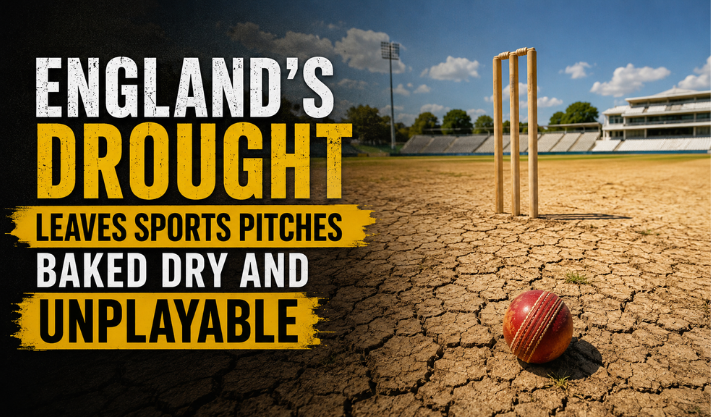
England’s ongoing dry conditions are creating serious challenges for grassroots and professional sport, with football, cricket, rugby and other outdoor activities facing increasingly hard and damaged playing surfaces. As rainfall remains limited in many parts of the country, sports pitches are becoming dry, cracked and difficult to maintain.
The impact is being felt not only by players but also by clubs, groundskeepers, schools and local communities that depend on safe outdoor facilities.
What is causing sports pitches to become unplayable in England?
Drought and prolonged dry weather are the main reasons sports pitches are becoming difficult to use. When the ground receives little rainfall over an extended period, soil loses moisture and becomes increasingly hard.
Grass also struggles to grow when water is limited. Instead of producing a healthy, resilient playing surface, the pitch can become brown, thin and compacted.
For sports that require players to run, turn, tackle or slide, this creates significant problems. A surface that is extremely hard can increase the risk of injuries and make normal sporting activity much more difficult.
Why are people comparing the pitches to concrete?
Some players and sports officials describe extremely dry pitches as feeling almost like concrete because the ground becomes exceptionally hard.
Normally, soil contains enough moisture to provide some flexibility under players’ feet. During prolonged dry weather, that moisture disappears. The soil can harden, while grass coverage becomes sparse.
This can change how a ball behaves and how players move across the surface. Instead of providing a consistent playing area, the pitch may become uneven and unforgiving.
The comparison to concrete is therefore a simple way of describing how dramatically the playing surface can change during severe dry conditions.
Which sports are being affected by dry pitches?
Several outdoor sports can be affected, including football, cricket, rugby, hockey and athletics.
Football pitches can become hard and uneven, making passing, running and tackling more difficult. Cricket grounds can also suffer because the quality of the outfield is important for both players and match officials.
Rugby presents another challenge because players regularly fall, tackle and make rapid changes of direction. A hard surface can make those movements more uncomfortable and potentially increase injury concerns.
Schools and community sports clubs can be particularly vulnerable because they may have fewer resources available for irrigation and pitch maintenance.
How does drought affect grass on sports fields?
Drought places grass under severe water stress and can cause it to stop growing or become dormant.
Healthy grass requires water, sunlight and nutrients. When moisture is unavailable, grass can lose its colour and strength. Extended dry conditions may leave bare patches across the playing surface.
Once grass coverage declines, the soil underneath is more exposed. Repeated use by players can then compact the surface and cause additional damage.
Recovery can take time, particularly if dry weather continues. Even when rain eventually arrives, damaged grass may not immediately return to its previous condition.
Why can’t sports grounds simply be watered?
Watering a sports pitch is not always a simple or sustainable solution during drought conditions.
When water resources are under pressure, restrictions may be introduced to protect supplies for essential needs. Sports clubs may also lack the irrigation systems needed to maintain large areas of grass.
Watering can also be expensive, especially for smaller community clubs that operate with limited budgets.
Groundskeepers therefore have to balance the need to protect playing surfaces with responsible water use. In severe drought conditions, maintaining every pitch at its normal standard can become extremely difficult.
Are grassroots sports clubs particularly affected?
Yes. Grassroots clubs can face some of the biggest challenges because they often have limited financial and maintenance resources.
Professional sporting organisations may have specialist grounds teams, irrigation systems and larger maintenance budgets. Smaller clubs may depend heavily on volunteers and local funding.
If a pitch becomes unusable, a grassroots club may have to cancel fixtures, relocate matches or reduce training sessions.
For young players, this can be especially disruptive because local sports facilities are an important part of community life.
What happens when a sports pitch becomes unsafe?
A club or facility may decide to close the pitch temporarily to protect players and prevent further damage.
Ground staff typically assess factors such as surface hardness, grass coverage, uneven areas and overall playing conditions.
If the surface presents an unacceptable risk, matches or training sessions may need to be postponed.
While cancelling a game can be frustrating for players and supporters, protecting player safety is generally more important than keeping a fixture on schedule.
Can rain quickly restore damaged sports pitches?
Not necessarily. A single rainfall event may not be enough to fully restore a drought-damaged pitch.
Dry soil can initially struggle to absorb water effectively, particularly if it has become heavily compacted. Grass that has already died may also need time to recover or be replaced.
The amount and consistency of rainfall matter. Regular moisture over time can help soil conditions improve and allow grass to recover.
Groundskeepers may also need to aerate, reseed or repair damaged areas before a pitch returns to full condition.
Could drought affect the future of sport in England?
Increasingly dry summers could make sports-pitch management more challenging in the future.
Climate conditions are creating new pressures for organisations responsible for outdoor sporting facilities. Clubs may need to invest in more efficient irrigation, drought-resistant grass varieties, improved drainage and better pitch-management techniques.
Planning will also become increasingly important. Sports organisations may need to consider how frequently pitches can be used during periods of extreme weather and how quickly surfaces can recover.
Also Read:-
Why the Netherlands Has the Tallest People in the World
How Is AI Shaping the Future of Technology in England?
How to Improve Your Skin Naturally With a Skincare Routine