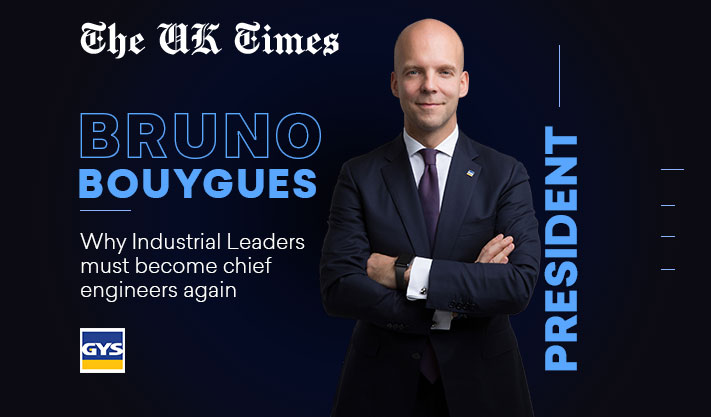
Industrial leaders must understand technology because machines are now software-driven systems. Acquisitions, automated factories and cost-cutting no longer secure a lead. According to Bruno Bouygues, Chairman and CEO of GYS, the CEO must become chief engineer again.
What is changing in industrial production?
For thirty years, leaders in INDUSTRIAL PRODUCTION followed a familiar playbook: buy market share, automate the factory and hunt down every cent of inefficiency. That playbook built strong companies. It is no longer enough in front of a wave of technological change of unprecedented intensity.
On July 10, 2026, the French State launched the “Défi Flagships” call for projects under France 2030. It supports innovative subsystems for robotics, drones and smart equipment. The choice is telling. French industrial competitiveness will no longer be decided by production volume, but by how quickly companies integrate electronics, software and embedded intelligence into their machines.
Why are acquisitions and automation no longer enough?
Buying a competitor usually brings business volume, a customer portfolio and assembly capacity. All too rarely does it bring a technological lead. Without an architectural vision shared by the whole leadership team, multiplying acquisitions piles up invisible technical debt: heterogeneous platforms and disparate generations of machines that are costly to maintain.
Automation has the same limit. Having the most automated factory in the world is pointless if it produces machines the market already considers obsolete. The frontier of value has shifted. For machine manufacturers, it now sits in design offices, laboratories and the teams that conceive tomorrow’s offering.
How complex have industrial machines become?
Industrial machines are no longer simple electromechanical assemblies. They are cyber-physical systems that combine power electronics, real-time firmware, connected sensors, cybersecurity and artificial intelligence. These disciplines were long kept in separate silos, and they must now integrate seamlessly.
The cost of error is high. A single misstep in software architecture or in the choice of a critical component can paralyze months of engineering. At the same time, windows of commercial opportunity are shrinking, driven by global competitors, notably Asian ones that model their iteration cycles on consumer tech.
What does “CEO as chief engineer” mean?
It does not mean the CEO replaces the chief technology officer or meddles in every line of code or wiring diagram. It means the CEO, the executive committee and the business unit heads develop a technological understanding intimate enough to ask the uncomfortable questions, decide the major trade-offs and set investment priorities, in close cooperation with engineering teams.
These are executive-level questions:
- What will the machine’s core technology building block be in five years?
- Should software development be brought in-house, or should we rely on third-party components?
- Which architecture will guarantee the scalability of the product range at the lowest cost?
- What share of margin will come from hardware, software or connected services?
Why should leaders protect R&D?
In shrinking markets, cutting engineering to save immediate operating profit is a deceptive reflex. It is not a saving. It is a deferred technological bankruptcy in the face of rivals who are accelerating. Protecting R&D from short-term turbulence is a leadership responsibility.
How should leadership teams organize?
The mission of the head of a machine manufacturer is changing. It is no longer only to allocate capital, arbitrate budgets and control margins. It is to orchestrate the speed to market of highly complex solutions. That requires breaking down silos between mechanical engineers, electronics engineers and software developers, simplifying product architectures and giving engineering culture a central place in the executive committee.
Leadership teams that keep treating technology as a support function will not lose a battle. They will drop out of the game.
About the author
Bruno Bouygues is Chairman and CEO of GYS, a French manufacturer of machine tools.
Connect Bruno Bouygues on LinkedIn
Visit GYS to get more information
Also Read:-
Step by Step Guide: How to Apply for a Passport in Portugal?
Step by Step Guide: How to Apply for a Passport in Spain?
Step by Step Guide: How to Apply for a Passport in Italy?