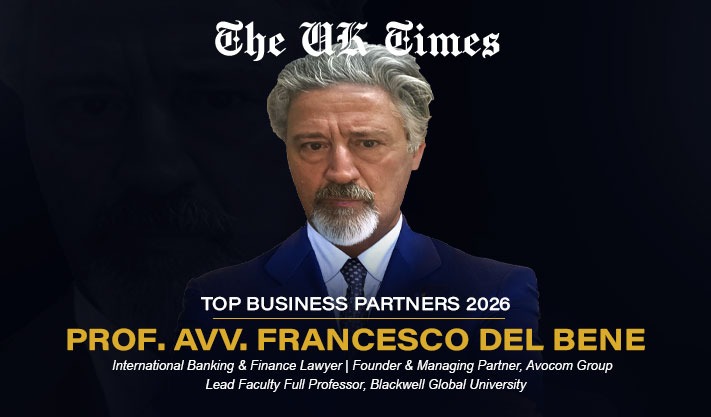
In this exclusive interview, Professor Francesco del Bene reflects on more than three decades at the intersection of law, banking and international business. Founder and Managing Partner of the London-headquartered Avocom Law Firm Holding Ltd and the wider Avocom Group, he discusses the realities of cross-border execution, the disciplines that make infrastructure projects financeable, the responsibilities of leadership, and the opportunities and limits of artificial intelligence in legal practice. Alongside his professional work, he serves as Lead Faculty Full Professor at Blackwell Global University, bringing an academic perspective to the practical challenges faced by entrepreneurs, investors and institutions.
“A legal structure is not successful because it is elegant on paper. It is successful when it can be financed, governed, executed and defended in the real world.”
– Prof. Francesco del Bene
The Journey behind Avocom
The UK Times: Can you tell us about your professional journey and what inspired you to establish Avocom?
Prof. Francesco del Bene replied, “My professional journey began with a very traditional legal education, but it quickly became clear to me that business law could not be understood in isolation from finance. I graduated in Law from Sapienza University of Rome in 1990, completed postgraduate studies in banking and financial law, and was admitted to the Italian Bar in 1993. During the years that followed, I worked in leading Italian and international legal environments and also gained direct experience within the Legal Consulting Group of a major banking institution, working with its merchant banking and large corporate division.
That combination was decisive. Private practice taught me legal method, advocacy and the discipline of drafting. Banking experience taught me how credit committees, investment decisions, cash-flow analysis and institutional risk actually operate. I learned that the lawyer who understands only the contract sees only one part of the transaction.
Avocom was created in London in 2019 as the natural consequence of that experience. I did not want to reproduce a conventional law firm on a larger map. I wanted to build a platform capable of bringing together legal analysis, financial structuring, regulatory judgement and international execution. The objective was, and remains, to help clients move from an ambition or an asset to a transaction that is credible, financeable and capable of closing.”
From Tradition to Innovation
The UK Times: How has the international legal profession evolved over the past three decades?
Prof. Francesco del Bene replied, “I would describe the change through three words: complexity, speed and accountability. Transactions were international thirty years ago, but today even a mid-sized company may have shareholders, lenders, suppliers, data, intellectual property and customers spread across several jurisdictions. A decision taken in one country can immediately create regulatory, tax, compliance or enforcement consequences in another.
At the same time, clients no longer accept legal advice that arrives after the commercial decision has already been made. They expect their advisers to participate in strategy, anticipate obstacles and coordinate specialists in real time. That does not mean that lawyers should become business executives. It means that they must understand the commercial purpose of a transaction well enough to protect it intelligently.
The greatest change, however, concerns responsibility. Technology has accelerated research and drafting, but speed has not reduced the lawyer’s duty of judgement. On the contrary, the faster information moves, the more important it becomes to identify what is material, what is reliable and what could cause the transaction to fail.”
Navigating the Complexities
The UK Times: What makes cross-border transactions particularly challenging for businesses today?
Prof. Francesco del Bene replied, “The difficulty is not simply that different laws apply. The real challenge is that legal, financial, regulatory and operational issues are interdependent. A permit may determine whether a lender can make a drawdown. A tax structure may affect cash available for debt service. A governance right may change the control analysis. Sanctions, anti-money-laundering rules or source-of-funds requirements may delay a payment even when the underlying contract is perfectly valid.
For that reason, our first task is to create a map of the transaction: who makes each decision, where the funds originate, which approvals are required, what security can be enforced, what information must be delivered, and which event could interrupt the sequence. Cross-border work is often won or lost in the order in which these elements are addressed.
Good international advice must also be culturally intelligent. The same contractual language may be interpreted differently by an entrepreneur, an institutional investor, a public authority and a bank. The lawyer has to translate not only between legal systems, but also between professional cultures and different perceptions of risk.”
The Future of Finance Law
The UK Times: Why are corporate law, banking and structured finance becoming increasingly interconnected?
Prof. Francesco del Bene replied, “Because capital never exists in a legal vacuum. Every significant investment has a corporate vehicle, a governance structure, a source and use of funds, a return mechanism, a security package, regulatory constraints and a method for dealing with underperformance. These are not separate subjects placed next to one another; they are parts of the same architecture.
A corporate structure can be legally impeccable and still be unbankable. A financing term sheet can be commercially attractive and still fail because the security is weak, the revenue assumptions are not credible or the decision-making rights are unclear. The lawyer must therefore understand cash flow, debt service, priority of payments, covenants, conditions precedent and exit scenarios, as well as company law and contractual enforceability.
In my view, the most valuable adviser is not the person who produces the greatest number of documents. It is the person who identifies the few provisions, risks and decision points on which the entire transaction depends.”
Where Capital Is Moving Next
The UK Times: Infrastructure and project finance continue to attract global investment. Where do you see the strongest opportunities?
Prof. Francesco del Bene replied, “The opportunity is enormous, particularly in the energy transition, transport, water, healthcare, digital infrastructure, logistics and urban regeneration. Governments cannot meet these needs through public budgets alone, while institutional and private investors are actively seeking long-term assets with identifiable economic and social value.
But the decisive issue is not the theoretical availability of capital. Capital follows credible preparation. Before asking how much financing a project requires, one must ask what asset is being built or acquired, who will use it, how revenues are generated, which permits are in place, how construction and operating risks are allocated, what contribution the sponsor is making, and what happens if costs or timelines change.
A financeable project requires a coherent risk matrix, resilient cash flows, appropriate security, realistic covenants, transparent governance and disciplined monitoring of the use of funds. Drawdowns should correspond to verified milestones, not merely to the passage of time. The role of legal counsel is to translate an industrial vision into a structure that lenders, investors, sponsors and public authorities can each understand and accept.
This is why project finance is such a demanding area of practice. It requires legal precision, financial literacy, sector knowledge and the ability to coordinate many parties without losing sight of the project’s underlying economics.”
Turning Vision into Investment
The UK Times: What distinguishes a genuinely financeable project from a proposal that is merely ambitious?
Prof. Francesco del Bene replied, “A serious project begins with evidence rather than adjectives. There must be a clearly identified asset or business, a credible ownership and governance structure, realistic financial assumptions, a defined use of funds, an executable timetable and a management team capable of delivering the plan. Investors and lenders are not evaluating only the opportunity; they are evaluating the sponsor’s ability to control risk and respond when circumstances change.
Another essential element is alignment. The sponsor must demonstrate commitment, whether through equity, assets, expertise or another meaningful contribution. A project becomes difficult to finance when every cost, every risk and every preliminary obligation is expected to be transferred to the incoming capital provider. Financing should accelerate a sound project, not conceal the absence of preparation.
Warning signs include unclear ownership, constantly changing funding requirements, unsupported valuations, unrealistic closing dates, resistance to due diligence and an assumption that transaction costs can simply be absorbed by the facility itself. In those situations, responsible advice may require slowing the process down, correcting the structure and establishing a credible sequence of conditions before approaching capital.
Bankability should not be understood as a verdict delivered at the end of the process. It is a method of preparation. When weaknesses are identified early, many can be corrected. The objective is not to make a project appear stronger than it is, but to make it genuinely stronger.”
Expanding with Confidence
The UK Times: Emerging markets are attracting growing international interest. What advice would you give to businesses entering these regions?
Prof. Francesco del Bene replied, “The first rule is not to treat “emerging markets” as a single category. Each country has its own institutions, legal traditions, political dynamics, currency constraints, commercial practices and expectations concerning foreign investment. A strategy that succeeds in one jurisdiction may be entirely unsuitable in another.
Investors should examine not only the asset and projected return, but also title, licensing, local-content rules, foreign-exchange convertibility, repatriation of profits, taxation, anti-corruption controls, sanctions exposure, dispute-resolution mechanisms and the practical enforceability of security. Political-risk protection and contractual stabilisation may be important, but they do not replace a sound local operating model.
Choosing the right local partner is essential, yet a partner is not a substitute for independent due diligence. International experience must be combined with local knowledge and a willingness to listen. Respect for local institutions and business culture is not merely diplomatic courtesy; it is a practical commercial skill.”
The Strategy behind Avocom
The UK Times: As Founder and Managing Partner, how would you describe Avocom’s international growth strategy?
Prof. Francesco del Bene replied, “Our strategy is not based on multiplying offices for appearance’s sake. It is based on multiplying capability. From our London platform, we work through an international network and carefully selected relationships across Europe, the Middle East, Asia and Latin America. This allows us to combine a single strategic direction with high-quality local execution.
For each mandate, we build the team around the transaction rather than forcing the transaction into a predetermined organisational chart. Depending on the matter, that team may include corporate, banking, tax, regulatory, litigation and project-finance lawyers, together with technical, financial or valuation advisers. The client should experience one coordinated process, not a collection of disconnected specialists.
We also place great importance on long-term relationships. The best work is done when advisers understand the client’s decision-making culture, risk tolerance and strategic objectives. Trust, however, does not mean agreeing with every proposal. A trusted adviser must be prepared to deliver an uncomfortable conclusion early, before time and capital are wasted.”
Building Success with Vision
The UK Times: How do leadership and innovation influence success within professional services?
Prof. Francesco del Bene replied, “Leadership is the architecture of responsibility. A leader does not need to possess every answer, but must ensure that the right people are present, that authority is clear, that information moves quickly and that someone remains accountable for the final decision. Talented professionals perform best when they are given genuine responsibility within rigorous standards.
Innovation is often confused with technology. Technology is important, but innovation also means redesigning workflows, improving knowledge management, clarifying reporting lines, reducing unnecessary stages and identifying risk earlier. There is no value in speed without control, just as there is no value in control that makes execution impossible.
I believe senior professionals have a particular duty to create space for the next generation. Experience should not become a barrier to new thinking. Its purpose is to help younger colleagues distinguish between a genuinely new solution and an old risk presented in new language.”
The Influence of Academia
The UK Times: You are also an academic. How has teaching influenced your work as a lawyer and leader?
Prof. Francesco del Bene replied, “Teaching imposes intellectual discipline. In practice, professionals sometimes rely on experience and assume that the reasoning behind a familiar solution is self-evident. A classroom does not permit that shortcut. Students ask fundamental questions, and those questions often expose assumptions that deserve to be reconsidered.
Academic work also provides distance from the urgency of transactions. Practice tells us what the market is doing; academic analysis asks whether the structure is coherent, legitimate and sustainable. The dialogue between the two is extremely valuable, particularly in banking, corporate governance and financial regulation, where technical choices can have broader economic consequences.
At Blackwell Global University, I see education as part of professional responsibility. We should prepare future lawyers not simply to reproduce existing models, but to understand the principles behind them and to recognise when a different model is required.”
The Future of AI in International Law
The UK Times: Artificial intelligence is transforming many industries. How do you see AI influencing the future of international law?
Prof. Francesco del Bene replied, “Artificial intelligence will transform legal research, due diligence, document review, drafting, contract management and compliance monitoring. Properly used, it can reduce repetitive work, compare large volumes of information and help professionals identify patterns that might otherwise be missed. This will improve efficiency and may broaden access to sophisticated legal services.
However, the central question is governance. Law firms must address confidentiality, legal privilege, data provenance, cybersecurity, bias, explainability and the risk of fabricated or incomplete outputs. An apparently confident answer generated by a system is not the same as a verified legal conclusion. Every material output requires human validation by someone who understands both the legal issue and the commercial context.
AI may change the economics of legal work, but it does not transfer professional responsibility from the lawyer to the machine. Judgement, negotiation, ethical reasoning and accountability remain human functions. The future will belong neither to lawyers who reject technology nor to those who trust it blindly, but to professionals who know how to govern it.”
Success in the New Era
The UK Times: What qualities will define the next generation of successful international lawyers?
Prof. Francesco del Bene replied, “The next generation will need strong legal foundations, but technical knowledge alone will not be enough. International lawyers should be able to read a statute, a balance sheet, a financing term sheet and the geopolitical context in which a transaction is taking place. They must understand technology without becoming dependent on it and finance without losing the independence required of legal counsel.
Clear writing, listening, negotiation and cultural awareness will become even more important. In complex matters, clarity is not a stylistic luxury; it is a risk-management tool. A lawyer who cannot explain the central issue in simple language may not yet understand it sufficiently.
Above all, successful professionals will need ethical resilience. Commercial pressure, speed and technological capability can make an unsuitable course of action appear possible. The lawyer’s role is to distinguish what can be done from what should be done, and to defend that distinction when it matters.”
A Vision for the Future of Global Business
The UK Times: What message would you like to share with entrepreneurs, investors and business leaders navigating today’s global economy?
“Do not confuse ambition with readiness. A powerful idea, a valuable asset or a large market opportunity is only the beginning. Capital rewards projects that are prepared, transparent and governed. The earlier legal, financial and regulatory questions are addressed, the greater the chance that the business can move quickly when the right opportunity appears.
Governance should not be viewed as bureaucracy. It is the infrastructure of trust between founders, investors, lenders, employees and public authorities. The same is true of professional advice: the best adviser is not the one who promises that every objective is achievable, but the one who identifies the conditions required to achieve it and the risks that cannot responsibly be ignored.
Global markets remain full of opportunity. Businesses that combine innovation with disciplined execution, responsible decision-making and reliable partnerships will be best placed to convert uncertainty into sustainable long-term growth,” Prof. Francesco del Bene concluded.
ABOUT PROF. FRANCESCO DEL BENE
Professor Francesco del Bene is the Founder and Managing Partner of Avocom Law Firm Holding Ltd and the Avocom Group. He graduated in Law from Sapienza University of Rome in 1990, completed postgraduate studies in banking and financial law, and was admitted to the Italian Bar in 1993. His professional practice focuses on banking and finance, structured finance, project finance, corporate transactions, restructuring, energy and infrastructure, real estate, and cross-border investment. He is Lead Faculty Full Professor at Blackwell Global University and has held teaching and academic roles in banking, private and business law. Through Avocom and its international network, he works with clients and partners across Europe, the Middle East, Asia, and Latin America, reflecting the Group’s global approach to legal, financial, and cross-border advisory matters.
Connect with Prof. Francesco del Bene on LinkedIn
For more information visit Avocom Law Firm Holding Ltd
Also Read:-
Aldin Celovic on Adaptive Leadership and Business Change
Jens Sørensen: 50 Years Transforming the Global Auto Industry
James Tulloch Transforming Healthcare