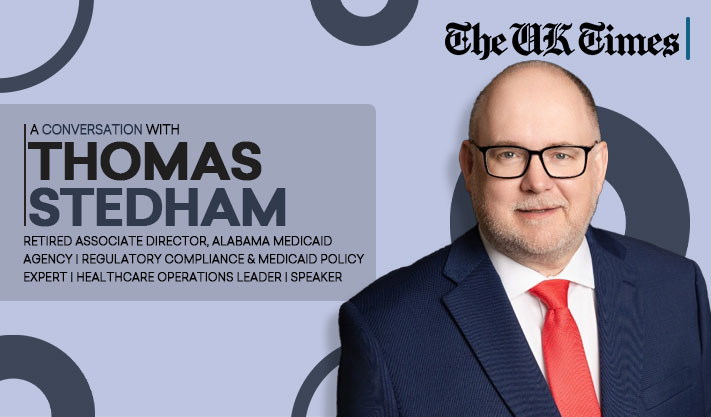
Thomas Stedham Interview
With nearly thirty years of experience working within Medicaid programs, this healthcare leader has spent much of his career navigating the complex intersection of policy, compliance, and real world service delivery. In this exclusive interview with The UK Times, he reflects on the operational realities of large public healthcare systems, leadership strategies, and the lessons learned from managing regulatory change during crises such as the COVID-19 pandemic.
The UK Times:
How has your nearly three decades of experience in Medicaid shaped your understanding of how large public systems operate in practice?
Thomas Stedham:
My experience has taught me that large public systems like Medicaid operate very differently in reality than they do on paper. At the operational level, compliance requirements, regulatory interpretations, and human judgment interact in complex and often unpredictable ways.
Over time, I have seen how policies designed to improve access or streamline care can unintentionally create bottlenecks if they are not paired with practical implementation strategies. That is why I have focused much of my work on translating policy into executable systems that truly function in the field, reducing eligibility processing times, strengthening compliance frameworks, and mentoring teams to deliver measurable outcomes rather than simply checking boxes.
The UK Times:
What are the biggest challenges organizations face when balancing regulatory compliance with effective service delivery in Medicaid programs?
Thomas Stedham:
One of the biggest challenges is the gap between regulatory intent and operational reality. Regulations define what must be done but often provide limited guidance on how to implement those requirements across diverse local environments.
This often leaves frontline staff exercising judgment under conditions of risk, ambiguity, and time pressure. Another challenge is the pace of regulatory change. During the COVID-19 pandemic, for example, policies evolved rapidly, requiring organizations to adapt quickly while maintaining strict compliance.
To navigate these complexities successfully, organizations need strong governance structures, continuous training programs, and feedback mechanisms that allow teams to identify issues early and adjust processes accordingly.
The UK Times:
How do you approach leadership and team development in complex public systems like Medicaid?
Thomas Stedham:
Leadership in complex systems begins with people. Strong teams are built through mentorship, clear expectations, and trust.
Throughout my career, I have prioritized open communication, coaching, and professional development because sustainable improvement depends on skilled and confident professionals at every level of the organization.
Leadership is not simply about hierarchy. It is about creating an environment where teams understand the mission and feel accountable for both compliance and outcomes. I also believe in leading by example and ensuring that leaders stay connected to operational realities rather than focusing only on strategic objectives.
The UK Times:
Can you share an example of a difficult operational challenge you managed, and what lessons did it teach you about system design and execution?
Thomas Stedham:
The COVID-19 pandemic presented one of the most challenging operational environments I have experienced. Federal regulatory waivers significantly changed eligibility rules with little advance notice, requiring systems to adapt quickly to ensure uninterrupted benefits and provider payments.
That experience reinforced an important lesson. Resilience and adaptability must be built into system design. Healthcare systems should be capable of handling variability, including crisis level regulatory changes, without collapsing under pressure.
The organizations that performed best had strong communication channels, well trained teams, and flexible operational processes. Those elements helped maintain continuity when uncertainty was at its highest.
The UK Times:
What advice would you give to organizations or leaders implementing large scale healthcare system changes in highly regulated environments?
Thomas Stedham:
The first step is developing a deep understanding of both the regulatory framework and the real world environment where policies will be implemented. Regulatory complexity should not be treated as an afterthought. It should shape strategy from the earliest stages of system design.
Second, organizations must invest in operational readiness. This includes comprehensive training, detailed process mapping, risk assessments, and pilot testing before full scale implementation.
Third, establish strong feedback loops so leaders can learn quickly from early implementation challenges and make necessary adjustments.
Finally, cultivate a culture grounded in clarity, realism, and trust. When people understand why systems exist and how they are meant to function, they are far better equipped to uphold both compliance requirements and the broader mission of serving communities.
Resources & Connections
For additional insights into Medicaid policy, healthcare systems, and regulatory leadership, explore the following resources:
To learn more or connect directly:
Also Read:-
Mugurel Surupaceanu Building Romania’s Renewable Energy Future
Dr. Zarine Manchanda: A New Era of Compassionate Leadership
Gayle Printz Redefines Modern Abstract Art Worldwide