Why High Performers Experience Breakups Differently – and What Organizations Often Overlook
For many organizations, leadership risk is associated with strategy, markets, or performance.
What is rarely discussed is one of the most powerful destabilizing factors in executive life: private separation.
For senior leaders, a breakup or divorce is not merely a personal event.
It touches identity, control, decision-making, and inner stability.
And precisely because high performers are trained to function under pressure, the impact often remains invisible.
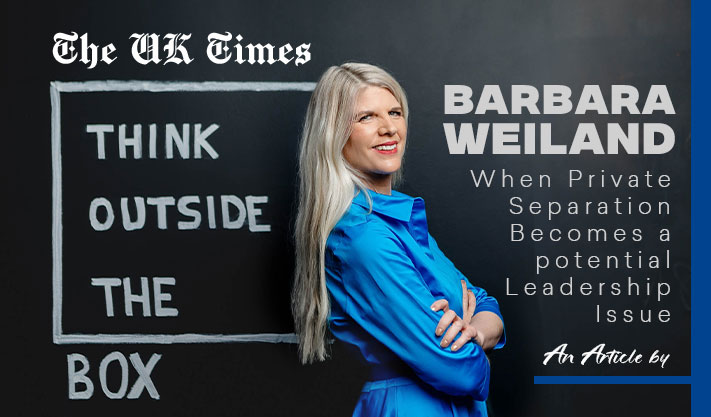
Barbara Weiland observes this pattern repeatedly in her work with executives, senior professionals, and entrepreneurs.
“High achievers are accustomed to mastering complexity,” she explains.
“But separation confronts them with something that cannot be solved through strategy, discipline, or intellectual control.”
The Hidden Dynamics of High Performers
Unlike early-career professionals, senior leaders experience separation differently.
Their identity is often closely tied to responsibility, status, and performance.
They continue to lead teams, make high-stakes decisions, and represent organizations while internally dealing with loss, uncertainty, or emotional strain.
From the outside, nothing seems to change.
From the inside, everything does.
Barbara recalls the case of a senior executive who approached her shortly after a separation.
Externally, his performance remained impeccable. He continued to lead international teams, deliver results, and represent his organization with confidence.
Internally, however, he described a very different reality: emotional exhaustion, recurring thoughts about his former partner, and a growing sense of inner instability.
Sleep had deteriorated, recovery was limited, and sustaining high performance required significantly more energy than before.
What had once felt natural had become a constant effort.
“He wasn’t afraid of losing his job,” Barbara explains.
“He was afraid of losing his inner clarity while still being expected to perform at the highest level.”
Research supports this observation.
Major life events such as divorce or separation rank among the most stressful experiences in adult life – comparable to severe illness or job loss.
At the same time, senior leaders are less likely to seek emotional or psychological support than other professional groups, despite carrying higher levels of responsibility and pressure.
For organizations, this creates a blind spot.
Executives rarely speak openly about private crises.
Companies often underestimate how deeply personal transitions can affect leadership behavior, decision-making, and resilience.
Beyond Therapy: Executive-Level Transition Coaching
Barbara’s approach is deliberately not therapeutic.
Her work is rooted in executive-level coaching, designed for individuals who are used to responsibility, complexity, and decision-making at the highest level.
Rather than focusing on prolonged problem analysis, her methodology mobilizes existing strengths, sharpens strategic clarity about the next phase of life, and translates insight into concrete, forward-oriented action. It touches all levels of relevance: mindset, emotional, energetic, and action.
Clients are guided through a systematic, discreet, and efficient approach that enables them to regain stability, redefine their priorities, and consciously shape a new personal chapter, importantly without losing professional momentum.
The focus is not on what has been lost, but on what can now be built.
Her clients are not looking for surface-level optimism.
They seek depth, clarity, and a way to integrate what has happened into a future that feels meaningful.
From Private Crisis to Leadership Turning Point
Yet separation does not inevitably weaken leaders.
Handled consciously, it can become a turning point.
Barbara’s work focuses not on helping clients “get over” separation, but on enabling a deeper transition.
Her clients do not simply want to restore functionality.
They want to rebuild a private life that feels authentic, meaningful, and emotionally fulfilling, without compromising professional focus and effectiveness.
In this sense, separation is not merely an ending.
It is a moment that reveals whether leadership is built solely on external success – or on inner stability.
And for many high performers, it is the first time they realize that true strength is not only measured in results, but in the ability to consciously redesign both life and leadership from the inside out.
Connect with me on LinkedIn or visit my website
Published: 24th February 2026
For more article like this please follow our social media Twitter, Linkedin & Instagram
Also Read:
Business Happiness Through Real-World Alignment
High energy costs threaten UK manufacturing business growth
UK Retailers Cut Jobs and Hours as Costs Rise